|
Bloggery - Highlights - Archives
Remembering Rhodry
February 26, 2011 - View Single Entry
My Rhodry passed three years ago today, age 13. I just posted a photo album to my Facebook page. You can see it even if you aren't on Facebook.
After Rhodry died, I listened over and over to Dave Carter and Tracy Grammer singing Carter's "When I Go." I've already listened to it twice this morning.
And should you glimpse my wandering form out on the borderline
Between death and resurrection and the council of the pines
Do not worry for my comfort, do not sorrow for me so
All your diamond tears will rise up and adorn the sky beside me when I go
Out of Control
February 22, 2011 - View Single Entry
So much of my education as a writer and a person of the female persuasion was rooted in the relationship between my mother and my father. Knowing this is one thing. Communicating it in writing is something else. Here's another one from To Be Rather Than to Seem.
By the time I reached teenagerhood, I was convinced that if I drank alcohol I would immediately turn into my mother. Turning into my mother was my idea of eternal damnation: my mother was an alcoholic, out of control, a sitting duck for my father's ridicule. I didn't touch liquor till I was 21.
I didn't smoke grass either, never mind experiment with harder drugs or hallucinogenics. This set me apart from my peers, especially once I got to college: radical antiwar activists were rarely teetotalers. But booze, marijuana, and acid made people lose control. Self-control was the only thing standing between me and eternal damnation.
I had my first glass of wine at a supper party thrown by a guy who lived upstairs from me in my dorm at Penn. I did not immediately develop an insatiable craving for alcohol.
The determination to distinguish myself from my mother, however, did not go away. And despite my determination, well, my mother and I have a lot in common. The older I get, the more of her face I see in my mirror.
How much of what I am is due to the genes I inherited from my mother and my father? How much is due to what I learned from them while I was growing up? Damned if I know. What I do know is that my parents, acting and reacting without conscious intent, created the environment that I had to live in. I improvised a way to live with it and in the process developed both my understanding of how the world works and my tools to deal with it.
In my family, if you wanted to be listened to and taken seriously, you had to keep your emotions in check. I most definitely wanted to be listened to and heard, to be taken seriously.
If you didn't get your facts right when arguing with my father, you were dead in the water. My mother misremembered facts, or exaggerated them, or made them up. Demolishing my mother's arguments was easy. I learned to build strong cases and to present them with authority. In my high school yearbook my advice to posterity was "Get your facts right, then always go through to the end with whatever you think is right, no matter what it is" (Harry St. John B. Philby).
At dinner one night, probably in the early 1970s, my father and I got into a discussion about the coup in which the colonels took power in Greece. I thought it had happened in 1966. My father said 1967. He got up to fetch the World Almanac, saying, "Because it's you, I'm going to look it up." He was right, it was 1967, but from him that was a high accolade and I've never forgotten it.
Little distinction was made in my family between what boys should do and what girls should do. My sister and I were not expected to help in the kitchen -- it probably helped that our mother wasn't much of a cook. My brothers weren't expected to fix things around the house -- it probably helped there that our father wasn't nearly as handy as he liked to think he was.
But though everyone said I was my father's daughter, I couldn't ignore the fact that I was my mother's too. She was female, and so was I. At my parents' parties, the men hung out in the living room talking about interesting stuff like politics and town affairs and architecture. Nearly all the women congregated in the kitchen talking about boring stuff like babies and cooking. I didn't want to be exiled to the kitchen.
From fifth grade through seventh, both boys and girls in my town went to dancing school, to learn how to fox trot and waltz and behave like junior ladies and gentlemen. Here I got a crash course in social expectations: girls had to wait till boys asked them to dance, boys got to lead even if they danced like oafs, girls weren't allowed to say no to the guy who came up and said, "You're almost the last one left -- I guess I have to dance with you."
For eighth and ninth graders, these classes were followed by less structured "socials." Here I saw my smart, funny, irreverent classmates acting like simpering idiots. I had no idea what was going on. It had something to do with the presence of boys, but what? I had two brothers, I knew my brothers' friends, and the kids who ran together in my neighborhood included both boys and girls. I'd never had to play a part with them; I'd always been myself.
Now, when I acted in ways I considered normal -- telling stories, talking politics -- these boys found me amusing. Not funny -- I liked being funny -- amusing. Something crucial had changed. I had no idea how to act.
I dropped out of those miserable socials in the middle of my ninth-grade year. My life revolved around familiar worlds with familiar expectations that I knew I could meet: school and the 4-H barn where my horses lived and where I hung out with other horsegirls after school every day. But the knowledge that there was an inexplicable adult world out there didn't go away. What prospects were there in that world for me, an intelligent girl who didn't know how to play stupid and didn't want to learn?
My mother's fate was out of the question. At the dinner table my father would ridicule her till she burst into tears, threw down her napkin, and fled to her room. When my father wasn't home, she'd get screaming drunk and yell, "I wish I'd never had you kids" and "You think you're so smart" and "What do you ever do to help?" (She had a point there: when my siblings and I couldn't manage to be somewhere else, we tended to make ourselves scarce.)
I fantasized having a mother who could guide me through the terra incognita that led to adult womanhood, but that wasn't going to happen. I remember at 12 years old sitting on the dryer -- in our house both washer and dryer were in the kitchen -- wearing green plaid shorts and swinging my legs back and forth so my sneaker heels went bang bang bang against the white metal. My mother told me she envied me because I was so strong. That's all you know, I thought. Some days I wish I was dead.
I wasn't going to suddenly acquire an older sister or a sympathetic aunt either. And if a guide had appeared who was willing and able to initiate me into the mysteries of adult womanhood, I probably would have refused the assistance. I wanted no part of those mysteries. I was on my own.
Vigilant though I already was about intoxicants, I was paying scant attention to food. I barely noticed when I started wolfing down candy bars during my sophomore year of high school, and it came as a shock when at the spring weigh-in in gym class I learned that I'd gained almost forty pounds since the previous fall. Forty pounds make a visible difference in a person's appearance, but I hadn't noticed the changes and if anyone around me did they didn't say anything.
Feeling my way through adolescence, I'd noticed that being physically attractive attracted boys, and in the presence of boys even smart girls turned stupid. I didn't identify with my physical appearance. The most important thing about me was my mind and the thoughts that swirled around in it. Safeguarding my mind demanded great vigilance. Fat was the strategy my subconscious came up with to keep boys away. It protected me against turning stupid, fluttery, and helpless.
Fat people are assumed to be out of control, and indeed my eating for many years was compulsive, but I wasn't out of control the way my mother was. New England WASPs are a circumspect people. Making scenes is a major taboo. My mother made scenes. I didn't. Drunk people, stoned people, people tripping on acid acted stupid. Out-of-control stupid. Stupid in my world was far more dangerous than ugly. The appearance of stupid was what got my mother creamed by my father.
I dressed to make myself invisible. I went through college in jeans and oversized shirts. This seemed to keep people from noticing that I had a body at all. My only flash of color was an antiwar or women's liberation button. If people read the writing on the button that was fine with me.
How Gerry Got Home to Wisconsin
February 20, 2011 - View Single Entry
The news from Wisconsin and especially the photos of the state capitol in Madison have me remembering Gerry Kelly. Gerry was a colleague of mine at the Martha's Vineyard Times. He wrote news stories, he wrote editorials, he wrote book, art, and food reviews -- Bob Potts called him "the greatest one-man band in the history of journalism," and that's no exaggeration.
Gerry turned out prose like yard goods, something I've never been able to do. Sure, it often wasn't carefully crafted and sometimes it was downright sloppy, but in the news biz you've often got holes to fill with very short notice. Gerry could do the job no matter what section the hole was in.
So Gerry was from Wisconsin, but he didn't like it and had little to do with whatever family he had there. When he wasn't on Martha's Vineyard or attending hearings in Falmouth or Boston, he'd head for Mexico, which he loved and where he'd had some dangerous adventures in his younger days.
In his later years, the M.V. Times was Gerry's life and Gerry's family. After he died in 1996, Times staffers took care of the arrangements. One way or another, the urn containing Gerry's ashes wound up in the office of editor in chief Doug Cabral.
Time passed. One day, in the spring of either 1997 or 1998, several of us were hanging around the newsroom BSing after Thursday morning staff meeting. Enter Tony the computer guru and business manager. "Gerry's up in Doug's office," he said, or words to that effect. "What are we going to do with him?"
Within minutes we were volunteering to take Gerry to places he loved or places he'd always wished to visit. This one was going to Mexico. That one was going to Paris. I was going to WisCon, the great feminist science fiction convention held annually in Madison, so I volunteered to take Gerry back to his home state.
Tony went up Beach Road to the pharmacy and came back with a dozen of the small plastic vials that you get prescription pills in. We divvied up a generous portion of Gerry's ashes and each of us took at least one vial home.
When I flew to Madison at the end of May, Gerry came with me. I thought hard about where Gerry would like to rest. Gerry was a hardcore political animal, so the state capitol was a no-brainer. One sunny morning I left the Concourse, where the con was held, and strolled the two blocks or so up to the capitol. Surreptitiously -- I wasn't sure that transporting ashes across state lines was legal without a permit, and for sure I wasn't authorized to do any landscaping on the capitol grounds -- I worked half the ashes into the soil under the hedge that encircles the monumental building.
Gerry also loved the water, so on another walk I scattered the rest of the ashes on Lake Mendota.
If Gerry were alive, he'd be in the thick of the demonstrations, collecting stories and then writing them up for the paper. You wouldn't need a weatherman to know that he was 100% sympathetic to the demonstrators, and if you read between the lines you'd figure out PDQ what he thought of Scott Walker.
Bread Consultant
February 19, 2011 - View Single Entry
Apart from the eating, kneading is my favorite part of making bread, so I've paid just about no attention to no-knead recipes. But a friend of a friend was trying to make no-knead bread according to a recipe in the online New York Times and it wasn't coming out right. Friend told friend of friend to call me, and yesterday he did.
Based on what he told me, I had a couple of ideas about what might be going wrong, but of course I had to try the recipe myself. Here's the online video version. I was so skeptical that 1/4 teaspoon of active dry yeast would do the job that I used a full teaspoon.
Friend of friend kept winding up with batter rather than dough, so I started with one cup of warm water, rather than the cup and a half called for in the video. I added the next quarter cup slowly -- and that turned out to be enough, maybe even a little too much: as I mixed the water into the flour, salt, and yeast, I sprinkled in a little more flour. The result was sticky, but it was definitely dough, not batter.
I covered the bowl with a towel and left it out on the counter overnight, about 12 hours. After Trav and I got back from our morning walk, the dough had pretty much "doubled in bulk," as the standard recipes like to say.
So I pre-heated my oven to 500 degrees F and put my cast-iron casserole dish in there to pre-heat too. I bought the casserole when I moved into this apartment four years ago, but I'd never used it: I'm just cooking for me, but I usually make four to six servings of anything at a time, and this casserole dish is just too small.
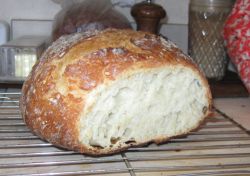
It proved perfect for my no-knead bread, however. The bread turned out great. Proof of the bread is in the eating, but since we're in the virtual world a picture will have to do.
Clean
February 16, 2011 - View Single Entry
This winter good laundry days have been hard to come by. I do my laundry at the Airport Laundromat. In recent years the price of a wash in one of the regular washers has gone down in November and up again around the beginning of May. This winter it's stayed at $5.25. That's OK. The dryers, however, are a ripoff. A quarter gets you a scant four minutes, and I'm here to tell you that when you've got several pairs of wet jeans it takes a fistful of quarters to get them dry.
Besides, I like hanging my wash out and letting sun and wind dry it. Partly it's because I'm cheap, but it's also the principle of the thing, and the fact that laundry dried outside smells good and lasts longer. Good drying days are scarce in any winter, and this winter they've been nearly nonexistent: wet wash would freeze solid long before it dried. I've run out of underwear a couple of times -- fortunately my friend Cris lets me use her washer and dryer, and I like going up there to hang out while she beats me three out of four games of Bananagrams.
This morning Travvy and I headed over to the airport with two overflowing canvas satchels of dirty clothes. Usually we stroll around the airport while the clothes wash, maybe visiting our buddies at Steve Atwood's Animal Health Care (veterinary hospital and boarding kennel) or looking up the guy who works for one of the rental-car companies, lives off-island, and has a Siberian husky named Maya. This morning, while three washers washed away, we drove around to the car wash at the Airport Business Park and gave Malvina Forester a bath.
The car wash offers a considerable discount if you buy at least eight gallons of gas at the affiliated gas station, so I did. Travvy got a free biscuit and much admiration from the guy at the pump. We drove around to the back, I punched in my number, Malvina started to creep forward . . .
As water sluiced down Malvina's sides and windshield and the big black scrubbers closed in,Travvy freaked out. He jumped into the back, but there was nowhere to hide. For a moment there I saw the headlines: WEST TISBURY WOMAN MAULED BY TERRIFIED DOG IN CAR WASH. Talk about nowhere to hide! I fed Trav Charlee Bears and hot dog pieces. He calmed down. We emerged into the daylight. Whew.
Today was a perfect drying day, breezy and bright. Everything was dry and wrinkle-free at least an hour before dark.
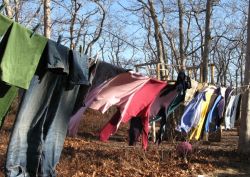
I wear fewer clothes in the winter -- it's too cold to get sweaty, so why change shirts or socks every day? Every time I shower is quite enough, and that's every three or four days. Winter clothes are heavier than summer clothes, though, and the line sagged with a half-dozen pairs of jeans, nine or ten turtlenecks, and four pairs of longjohns. Socks and underwear dried on the drying rack up on my deck.
So dark fell on a clean car and drawers stuffed with clean clothes. It's immensely satisfying to know that I'm set for another three weeks or so. Today I did good.
|